

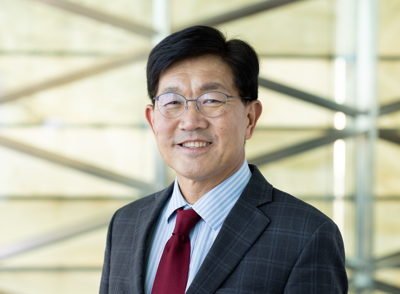
Prof. Hong G. Im
Professor of Mechanical Engineering Clean Energy Research Platform King Abdullah University of Science and Technology (KAUST) Thuwal, Saudi ArabiaAbstract
Accelerated High Fidelity Simulations of Reacting Flows Using Analytic and Data-Based Reduced Order Models
Combustion of conventional and renewable fuels continues to play a vital role in zero-carbon sustainable energy. Advances in computing power have enabled predictive simulations of complex phenomena involving turbulent transport and reactions at great detail, but complete description of the practically relevant problems remains a challenge due to the wide spectrum of physical and temporal scales.
This presentation will start with a review of some current research activities in computational combustion, followed by an overview of historical developments in mathematical and computational approaches to reduced order models for accelerated high fidelity reacting flow simulations in modern computing hardware. Classical theories of computational singular perturbation (CSP) will be discussed and its application to dimensionality reduction by skeletal mechanisms and accelerated solver algorithm will be described, including the recent breakthrough in hash-map reuse of chemical basis vectors.
Next, the principal component analysis (PCA) will be presented as a classical data-based dimensionality reduction technique, followed by the successful implementation of the combined PCA–CSP approach. Finally, data-based construction of latent space time integration using the autoencoder and neural ODE (AE–NODE) will be discussed as a new paradigm of deep neural network (DNN) application to accelerated computing, with theoretical insights obtained by information theory.
Biography
Hong G. Im received his B.S. and M.S. from Seoul National University, and his Ph.D. from Princeton University. After postdoctoral researcher appointments at the Center for Turbulence Research, Stanford University, and at the Combustion Research Facility, Sandia National Laboratories, he held assistant, associate and full professor positions at the University of Michigan.
He joined KAUST in 2013 as a Professor of Mechanical Engineering and currently serves as Deputy Chair of the Clean Energy Research Platform.
He is a recipient of the NSF CAREER Award and the SAE Ralph R. Teetor Educational Award, and has been inducted as an International Member of the National Academy of Engineering of Korea, a Fellow of the Combustion Institute and of the American Society of Mechanical Engineers (ASME), and an Associate Fellow of the American Institute of Aeronautics and Astronautics (AIAA). He has served as an Associate Editor for the Proceedings of the Combustion Institute, and currently sits on the Editorial Board for Energy and AI.
Professor Im’s research and teaching interests are primarily the fundamental and practical aspects of combustion and power generation devices using high-fidelity computational modelling. Current research activities include direct numerical simulation of turbulent combustion at extreme conditions, large eddy simulations of turbulent flames at high pressure, combustion of conventional and renewable fuels, spray and combustion modelling in advanced internal combustion engines, advanced models for pollutant formation, plasma-assisted combustion, and reduced order models for accelerated computing.
Attend this session
The Saudi HPC/AI Conference runs 26–28 October 2026 at KAUST. Attendance is free, but registration is required.